Monday, June 10, 2013

May Moments on Allen Road


I
t was always going to be rather doubtful that May would produce anything outstanding, or indeed come up with any real species diversity or abundance in numbers of any given species.  May is late autumn in the southern hemisphere and we have already experienced some rather chilly evenings.  It does not auger well for the rapidly approaching austral winter.  And birds tend to be scarcer during the colder spells.

Not that May 2013 was numerical retarded on previous Mays.  The 49 species was admittedly well below the 63 of May 2003 [the current record] but only one behind the 50 species of May 2004.  It was one better than the 48 of 2010 and two ahead of the 47 species in May 2009.  It clearly overshadowed the 30 species of May 2006 [still the lowest May on record for Allen Road].

There were, as always, the regular faces, or should that read, ”the regular feathers”?  They were there each and every day: the Laughing Kookaburra Dacelo novaeguineae and Torresian Crow Corvus orru; the Australian Magpie Cracticus tibicen and Magpie-lark Grallina cyanoleuca; the Galah Eolophus roseicapillus and Grey Butcherbird Cracticus torquatus; the Rainbow Lorikeet Trichoglossus haematodus; the Apostlebird Struthidea cinerea and Noisy Miner Manorina melanocephala; the Crested Pigeon Ocyphaps lophotes and Bar-shouldered Dove Geopelia humeralis; etc.

They were accompanied by the less frequent but nevertheless reasonably well-presented regulars: the Australian Wood Duck Chenonetta jubata; the Masked Lapwing Vanellus miles; the Sulphur-crested Cockatoo Cacatua galerita and Australian King-Parrot Alisterus scapularis; the Blue-faced Entomyzon cyanotis and Striped Honeyeaters Plectorhyncha lanceolata; the Striated Pardalote Pardalotus striatus; etc.

On the other hand, a number of species managed to put in only the one appearance throughout the entire month.  The Australian Owlet-nightjar Aegotheles cristatus [never known to outstay its welcome] called on20 May; the Bush Stone-curlew Burhinus grallarius early in the month, on 2 May; the Scaly-breasted Lorikeet Trichoglossus chlorolepidotus on 5 May; the Fan-tailed Cuckoo Cacomantis flablliformis, while in evidence all around us in the broader South Burnett, visited us only on the 24th of the month; the Pied Butcherbird Cracticus nigrogularis, always in the shadow of its smaller cousin, the Grey Butcherbird, called only on the last day, 31st May.

Then there was the Black Kite Milvus migrans on 5 May.  It was the first new addition to the Backyard List in a long time.  We’d walked to the “top” end of Allen Road [to its junction with the Nanango-Maidenwell Road.  I spotted the “crow” flying across; Fay corrected the call to Black Kite on seeing the distinctive forked tail.  Oddly enough, two Whistling Kites, perhaps a breeding pair, were in the same airspace at the same time and to all intents and purposes it appeared as if the Black Kite was “associating” with the Whistling Kites.
 
Photograph from www.birdway.com.au 
 
The sudden appearance of the Black Kites in and around Nanango is a tale for another place at another time.


Friday, May 3, 2013

April Report


On a number of occasions throughout the month it appeared to be a real struggle to survive April – in birding terms.  Much of our monitoring was restricted to the weekends but with several major projects in hand [e.g. completing the new pigeon loft; lining the inside of the garage to prepare for a brewing area] at times the tallies became quite meagre [only two species recorded on 26 April].  Nevertheless we managed 19 surveys which produced a tally of 53 species; our lowest average [2.78] species-per-survey score since 2008 when we finished April with an average of 1.60 species per survey [45 species over 28 surveys].
 
It was our third lowest species-per-survey average since Allen Road records began in 2002 [2007 came in at 2.63, 50 species over 19 surveys].

There were nevertheless some notable highlights, not the least of which being the sudden and unexpected return of the Olive-backed Oriole Oriolus sagittatus
which we thought had made its swansong appearance in the area back on 22 February 2013.  It surprised with a brief vocal entrance on 6 April at the Nanango Fauna Sanctuary, followed by four whirlwind encores at Allen Road on 21, 25, 27 and 28 of the month.

The Australian Owlet-nightjar Aegotheles cristatus, which had first reappeared on 16 March [following an absence since 16 September 2012] called on three occasions during April; 21, 25 and 28.  The Southern Boobook Ninox boobook called on 4 and 27 April.
 
The Pacific Baza Aviceda subcristata put in two consecutive appearances; 13 and 14 April.  On 25 April we were graced by a Whistling Kite Haliastur sphenurus and a Collared Sparrowhawk Accipiter cirrocephalus; the latter returned on 28 April.
 
A pair of our “Backyard Darlings”, the Glossy Black-Cockatoos Calyptorhynchus lathami, was noted flying east to west across our property on 8 April.  The Yellow-tailed Black-Cockatoo Calyptorhynchus funereus called towards the end of the month [28th].
Six Little Lorikeets Glossopsitta pusilla, their first visit since 24 March, flew over on 4 April.  The following day we noted a trio of Red-rumped Parrots Psephotus haematonotus at the Andrews Road end of Allen Road.
A Fan-tailed Cuckoo Cacomantis flabelliformis was prominent on 21 April; a week later [28th] the Spiny-cheeked Honeyeater called for the first time since 23 January.  The Grey Fantail Rhipidura albiscapa on 25 April was its first appearance here since July 2012!
Yes, April may have felt slow but there was quality in the species that put in an appearance.  May is an entirely new month.
 

Friday, April 19, 2013


PALE RIDERS – AVIAN STYLE

                                        Allen Road.  Look for the circular dam surrounded by woodland.

Well, it has been a long weekend!  For those unfamiliar with this between-wars expression it refers to the long break between the two World Wars; in this case I note with some horror that my last blog was on 4 April 2012- a year ago!  I did hint at the possibility in a couple of past blogs.  Pressure of work since Education Queensland took on board the Australian Curriculum; 10- to 12-hour days are not as uncommon as some may believe.  Squeezing the proverbial quart into a pint pot.  Not bad for a bunch of nerds who only work 9 to 3, get ten weeks a year paid holidays and do little more but throw out prepared worksheets for their students to complete while “Sir” sits back to read the sporting pages of the local rag!

Still, that’s education, this is birds.  If I wanted to talk education I’d start a more appropriate blog.

Not that readers have missed much during the interim.  April 2012 saw a monthly tally of 44 species for Allen Road with only the trio of night visitors [Tawny Frogmouth Podargus strigoides, White-throated Nightjar Eurostopodus mystacalis and Australian Owlet-Nightjar Aegotheles cristatus] being worth the mention.

Neither May [32 species], June [36 species] nor July [38 species] fared much better, although the Owlet-nightjar turned up again in the first two of those months and the diurnal Yellow-tailed Black-Cockatoo Calyptorhynchus funereus in May along with the crepuscular Bush Stone-curlew Burhinus grallarius [July] did cause a momentary flutter of the heart.

It took until September to break the half century mark and until December to spill over the 50 mark [63].   August [47 species] brought forth some avian beauties: the Pacific Baza Aviceda subcristata, a Brown Goshawk Accipiter fasciatus and one of the locally iconic Wedge-tailed Eagle Aquila audax.  Both the Bush Stone-curlew and Yellow-tailed Black-Cockatoo put in another appearance.   The Olive-backed Oriole Oriolus sagittatus became the first of the summer migrants to announce that warmer days were upon us.

Among a few other notable worthies, September 2012 produced only the sixth Eastern Barn Owl Tyto delicatula for Allen Road [although up until recently it was considered no more than a subspecies of Tyto alba].  The second [and third] of the summer heralds, the Channel-billed Cuckoo and Eastern Koel Eudynamys orientalis appeared.  The Little Bronze-Cuckoo Chrysococcyx minutillus was present on three consecutive days, something it had not done since November 2007.


October 2012 was the month of the cuckoos. The Little Bronze and the Channel-billed had already been here a month but now it was the turn of the Black-eared Cuckoo Chrysococcyx osculans, Horsfield’s Bronze-Cuckoo Chrysococcyx basalis and Shining Bronze-Cuckoo Chrysococcyx lucidus to have us draw in breath.  The first appearance of the Ground Cuckoo-shrike Coracina maxima since September 2011 was a pleasant bonus- outstripped only by the Australian Hobby Falco longipennis, last seen here in June 2006!

November and December were somewhat truncated months while Fay and I gallivanted and birded our way across Goa in India.  Nevertheless before our departure in late November we managed to add Fan-tailed Cuckoo Cacomantis flabelliformis and Brush Cuckoo Cacomantis variolosus to the growing Cuculid list.  The raptor list was further graced by the Collared Sparrowhawk Accipiter cirrocephalus and Grey Goshawk Accipiter novaehollandiae.

And so 2012 came to an end.  For those interested in such matters, the final Year List for Allen Road was 96 species, our fifth best year [with 2006, at 110 species, still reigning supreme].

January 2013 opened with the axiomatic bang in more ways than one.  To begin with the monthly tally reached 70 species, our highest ever January count in 12 years of monitoring; it surpassed the previous record [January 2007] by three. 

Both the Wonga Pigeon and Yellow-rumped Thornbill put in their first appearance since December 2010.  As if having the Red-tailed Black-Cockatoo fly by on 10 January wasn’t exciting enough, the bird re-appeared on the 20th.  But wait, there was more; the Yellow-tailed Black-Cockatoo also put in a duet of appearances during the month.  And still more, the darlings of our Backyard List, the Glossy Black-Cockatoo, were here on the 6th and 7th of January.  Little surprising therefore that in January we felt that our Calyptorhynchid cup runneth over.

Towards the end of the month we had our Allen Road megatick! 

 Photograph taken by tytotony.blogspot.com

We weren’t even seriously birding, simply enjoying a cup of tea on the east verandah overlooking The Doughnut and observing a small troupe of Apostlebirds Struthidea cinerea frolicking about in the Middle Compound.  There is no doubt some perfectly sound scientific explanation as to what the birds were actually engaged in [birds don’t have a sense of humour, nor do they “play”] but one of them grabbed a small length of yellow tape in its beak and somersaulted over itself.  It repeated this unusual behaviour a number of times.

Fay was the first to notice the strange birds among the weeds, towards the front of The Doughnut.  She immediately drew my attention to it and after a moment’s hesitation – we’d last seen it back in January 1995 at Noela Marr’s and Cyril Hembrow’s Kin Kin property- identified them as Pale-vented Bush-hen; an adult with a juvenile.  It was the first ever record of the species for Allen Road and new ticks no longer flow as they did in the early years.

Almost in the same breath, the pair raced off east towards the Middle Compound; one immediately passed through the mesh wire, the second bounced off the fence before succeeding on its second attempt.  In the blink of an eye they disappeared in the long grass, never to be seen again.

That was, remains, a hard act to follow.

Nor did February manage to rival its predecessor; a more humble tally of 60 species.  March continued the downward trend, reaching only 58 species,  As I pen these few words together, the current month’s tally [at 16 April] stands at 47 species but that does include a magnificent flyover by a pair of Glossy Black-Cockatoos a week ago.


.

Wednesday, April 4, 2012

A Matter of Grey

Grey Goshawk in flight
Photo by Russell Jenkins, available at the Australian Bird Images Database: http://www.aviceda.org/abid/index.php

Seeing one Grey Goshawk Accipiter novaehollandiae in a week [http://www.birdingsouthburnett.blogspot.com.au/] is joy enough for the soul of most Queensland birders but to see three over the same weekend – and two of those as a pair- is rapture beyond reckoning!  All the more as at the time we were not birding, simply enjoying a respite from a number of household and backyard chores that needed doing before the sun became too fierce to work in.   We were sitting on the front verandah with a cuppa each.
It was the Noisy Miners Manorina melanocephala that first attracted our attention.  The species has a number of alarm calls, one distinctly warning of the approach of a raptor.  It becomes almost second nature to look up when the Miners alert you to the presence of some danger.
Fay spotted them first, pair of Grey Goshawks just beyond the roofline of our neighbour’s house.  They dipped below our line of vision, reappeared momentarily as they flew towards the wooded area between our two properties, vanished from view again and then suddenly burst out into the open sky.
It was the briefest of glimpses.  Rare views of any delightful bird are never long enough to satisfy the inner being of a birder but it was long enough to note the deeply veed wings as the pair cavorted around each other, dropped from view and reappeared, still in gracefully slow motion before going on their way beyond our line of sight.
We didn’t even have the binoculars at hand but then the pair had been close enough to fully appreciate with the naked eye.
It remains the gem of the 35 backyard species, including the Australian Owlet-nightjar Aegotheles cristatus of the evening, recorded that day.


Saturday, March 17, 2012

Glossy Black-Cockatoo


That’s life! Sometimes the end result of a search is another tick to your Lifelist, or simply another good view of a favourite avian species. On the other hand, on occasions, the fruits of diligent observation and searching can amount to little more than a memory, the fading excitement of what might have been.

We experienced the latter on Saturday [17 March]. Not that we were birding avidly at the time. Far from it. There were too many tasks around the Allen Road property listed as needing urgent attention to allow for any serious birding. Nevertheless, as a matter of habit, even while filling in another deepening rut [clay soil and heavy rainfall make for sloppy track surfaces that rapidly degenerate into seeming chasms] eyes and ears remained alert to the possibility of new, or at least interesting, birds passing by.

It was during one of a number of tea breaks that our attention was alerted. Or rather, Fay’s attention was brought into focus. I was inside, continuing to redefine our Lifelist; Fay was on the north verandah reading another chapter of yet another book [she can read the average who-dun-it novel in a couple of days].

Fay called me out on the second call of the Glossy Black-Cockatoo Calyptorhynchus lathami.

You need to understand that unlike its near local relatives, the more common Yellow-tailed C. funereus and the rarer Red-tailed Black-Cockatoo C. banksii, both raucous variants of the family, the Glossy [actually a brown rather than a black cockatoo] is a comparatively quiet bird. Its call could go undetected; its arrival unnoticed as it locates a suitable tree to silently chew away on seed pods.

We both ceased whatever it was we were engaged in doing at the time, grabbed our binoculars [never too far from hand], raced down the front steps and cautiously approached what we refer to as the “Northwest Quadrant” of the property [not that the property is actually divided into four equal parts, nor indeed are there four definable segments]. Fay had heard the bird call from this section; our last sighting of it had been here.

It wasn’t new; it wasn’t going to be a “megatick”. My records indicate that since first seeing the species at Glen Innis [northern New South Wales] back in May 1999 [July 2001 for Allen Road] we had 93 subsequent sightings recorded – the last [at Allen Road] as recently as October 2011.

But it was always going to be exciting! As I have written elsewhere, they remain the darlings of our backyard bird species.

We walked, we stopped, we listened for the tell-tale sound of casuarina seed pods being chewed. Nothing. We walked on, we stopped at intervals and again listened intently for any giveaway indications of their presence – they often travel in trios although we have noted pairs and on one occasion a solitary bird.

Nothing.

We crossed the track and explored along the eastern fence line, heading back south towards the house. Our neighbour, not a birder, has an impressive stand of casuarinas in the northwest corner of his property [abutting our “Northeast Quadrant”]. It was the original source of the seeds used to start our own planting program.

Nothing.

Clearly the Glossy had merely been passing through and to add insult to injury, the rain started to come down. Those remaining ruts and potholes will have to await another day, as of course will our next sighting of the Glossy Black-Cockatoo.

Glossy Black-Cockatoo

Sunday, February 19, 2012

Over the Summer Hump


It has been a rather unusual austral summer. We were warned to expect a very wet period and even though there have been patches of heavy rainfall – 40mm in the space of a little over an hour on one particular day- the predicted wetness has failed to eventuate. It may of course still come in the remaining days of summer but it would have to come down in proverbial bucketsful to come within coo-ee [Australian slang term] of last January’s deluge. No one is complaining. Mostly we remain grateful that Mother Nature has seen fit to control her vagaries.


The waning of summer heralds the gradual departure of our regular seasonal migrants. At its peak we can boast anything up to a dozen or so visitors, ranging from those that reappear almost as regular as clockwork to those that put in an occasional appearance. The Cuculidian trinity of Horsfield’s Chalcites basalis, Little Chalcites minutillus and Shining Bronze-Cuckoos Chalcites lucidus are examples of the latter. None has been observed during this current summer but on the other hand the Brush Cuckoo Cacomantis variolosus has been more prominent than in previous years and the Black-eared Cuckoo Chalcites osculans made its first ever appearance on Allen Road [13 November 2011] and was last heard as recently as 15 February 2012.


One of the earliest indicators of summer has been the raucous Channel-billed Cuckoo Scythrops novaehollandiae. This season it was first heard along Allen Road on 11 October 2011 and remained a regular feature of the dawn chorus [and later in the day] until the end of January 2012. Following a brief pause it reappeared and was last heard on 8 February which in itself raises an eyebrow -last year it was still here until mid-March.


The Australasian Figbird Sphecotheres vielloti has always been something of an anomaly. It arrives, hangs around for a couple of days before disappearing to then put in an occasional subsequent visit before departing to wherever it is figbirds depart to when not along Allen Road. It arrived on 24 September 2011, remained on an almost continuous basis until mid-October, disappeared for the best part of a month, reappearing on 12 November, only to disappear again. It put in a brief appearance on 29 December, vanished and called for the last time on 28 January 2012.


Alongside the Figbird, Fay and I often pair the Olive-backed Oriole Oriolus sagittatus although its stay with us is more settled. It arrived at the end of September 2011 and was still with us, albeit rather less vocal, a couple of days ago. However, Fay and I are beginning to suspect that this species is perhaps not as migratory as originally suspected. In 2010 it was recorded at least half a dozen times in every month barring June; there is one record of the Oriole at Allen Road in June 2008! Food for thought?


Both the Little Philemon citreogularis and Noisy Friarbird Philemon corniculatus remain iconic heralds of summer. The former was among the first three birds we noted when looking over the property as a potential purchase back in April 2001. The Noisy has been known to arrive in early July and hang around until mid-April. The Little can be a month later in arriving but can linger a little longer than its cousin.


No summer would surely be complete in this neck of the woods without the temporary stay of the Dollarbird Eurystomus orientalis and the Eastern Koel Eudynamys orientalis [the iconic “Stormbird”]. This season we have been blessed with two breeding pairs of Dollarbirds on the property. The first appeared on 11 October 2011 and are expected to depart any time soon, although in both 2003 and 2010 they were still about as late as March. Similarly, the Koels are expected to leave sometime in February, although they too have been known to stay until March – indeed, we have one record in the South Burnett of Eastern Koel in May!


Finally we touch upon one of mine and Fay’s favourite summer migrants, the Sacred Kingfisher Todiramphus sanctus. We almost thought that it had deserted us this season: last year it nested in the tree right on the southern boundary fence of the property; in earlier years it has nested in the old ironbark within ten metres of the house. However, it was simply a matter of seeking out its new location, in the northeast quadrant.


The kingfisher usually arrives in September, although we have a record of one in the South Burnett at the end of August 2009. Most remain through to February/March although, again, there is a record as late as May 2010 [distance of locations makes it unlikely to be the early 2009 arrival].


They come, they linger a while, they go. For many of our summer migrants that time of the season is upon them. Even when they remain that while longer they normally become more subdued, less raucous in their call. All adding to the unescapable reality that summer is over the hump and on the downward slide into autumn [fall].

Tuesday, January 3, 2012

NEIGHBOURLY SURPRISES

Yes, it’s been a long time between drinks. There is of course the usual array of excuses, primarily centred on an increasing workload at school and the coming of the Australian Curriculum to Queensland in 2012. The quinquennial colonoscopy put paid to a few days before Christmas.

Nevertheless, throughout, birding along Allen Road has continued where circumstances permitted, with the unexpected arrival of a Black-eared Cuckoo Chalcites osculans as one of the season’s highlights.

Photograph by Graeme Chapman. http://graemechapman.com.au

Frustratingly, while we have heard it call from all points of the compass around the property all our efforts to actually locate the bird, with the exception of one fleeting view as the bird raced away, have proved fruitless.

We console ourselves with the knowledge that the same was true of its relative, the Brush Cuckoo Cacomantis variolosus which, in a similar manner, eluded our binoculars for months. Then, on Thursday 29 December 2011, during one of our customary early morning walks along Allen Road, we spotted the bird calling from a smallish tree to our left. The walk was suspended for a few moments while we savoured the view.

Photograph by Ian Montgomery. birdway.com.au

That’s all part and parcel of birding along Allen Road. On a daily basis you see and/or hear the regular residents, the Torresian Crows Corvus orru and Noisy Miners Manorina melanocephala, the Australian Magpies Cracticus tibicen and Striped Honeyeaters Plectorhyncha lanceolata but every now and then you come across the more unusual – the Australasian Bittern Botaurus poiciloptilus [4 November 2001] flying over your head, the Black-faced Monarch Monarcha melanopsis [new to the Backyard List in December 2011],

Similarly, summer has its regulars. The Sacred Kingfisher Todiramphus sancta and Channel-billed Cuckoo Scythrops novaehollandiae, the Little Friarbird Philemon citreogularis and Olive-backed Oriole Oriolus sagittatus but again, there can be the unexpected – the Rainbow Bee-eater Merops ornatus and Australasian Figbird Sphecotheres vielloti which comes, remains a day or two and disappears to occasionally put in a rare repeat visit in the one season.

And then of course there are always the part-time birding neighbours who simply floor you with a totally unexpected revelation.

It was back in July 2009 that Les, an ex-Vietnam Veteran two blocks away, first informed us of the aberrant flock of Budgerigars Melopsittacus undulatus he’d noted along Allen Road a number of years earlier By the time he appreciated that Fay and I were more than simply interested, more akin to obsessed, he could recall few further details. The report is duly entered in our computer records in the hope that the birds return to Allen Road one day.


We were in for an even greater surprise during the last weeks of 2011 when we walked over to our neighbours, Denis & Jeanette, both avid backyard bird feeders with a tabletop fieldguide but who play little part in active birding. It was the evidence of the photographs that stunned us.


The Rose-ringed Parakeet Psittacula krameri, clearly an escapee and therefore probably failing to meet the “viable population” criterion, had, on and off, been visiting their backyard birdtable for the past two or three years. Jeanette photographed it on one of those occasions. Its continued presence over that period leaves many unanswered questions.


Photograph by Jeanette McBryde.


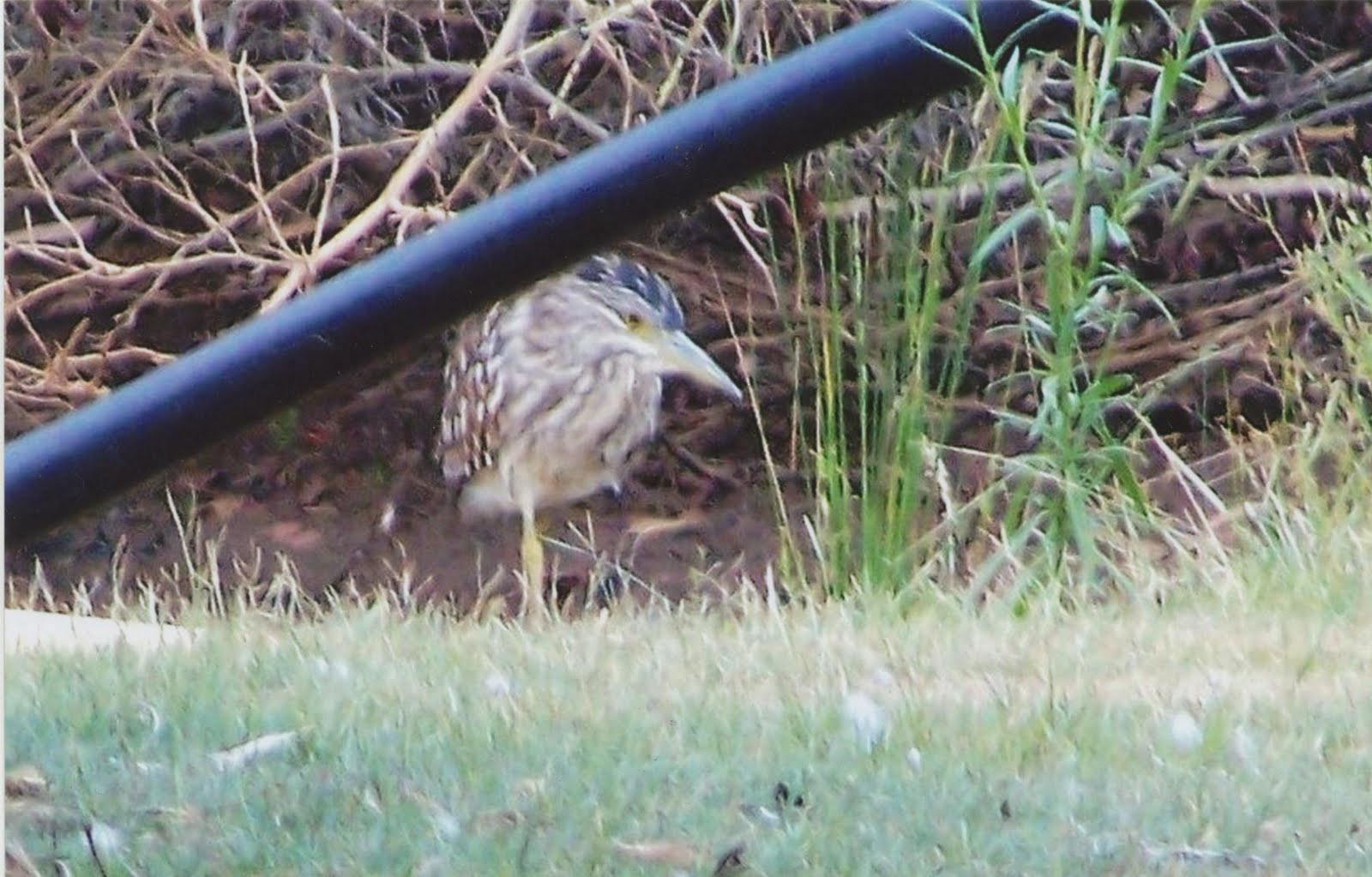
As if the parakeet wasn’t enough of a jolt to the system, Jeanette then proudly handed over her photograph of a “strange bird” she had photographed on the morning of 5 December 2011. She had spotted it skulking on the edge of their small front dam, under the pipe leading from pump to water – a Striated Heron Butorides striata!

Photograph by Jeanette McBryde.


Happy 2012 to one and all. May the new year bring you all those as yet unticked species and may all your birding experiences be pleasant but challenging.