Sunday, February 19, 2012

Over the Summer Hump


It has been a rather unusual austral summer. We were warned to expect a very wet period and even though there have been patches of heavy rainfall – 40mm in the space of a little over an hour on one particular day- the predicted wetness has failed to eventuate. It may of course still come in the remaining days of summer but it would have to come down in proverbial bucketsful to come within coo-ee [Australian slang term] of last January’s deluge. No one is complaining. Mostly we remain grateful that Mother Nature has seen fit to control her vagaries.


The waning of summer heralds the gradual departure of our regular seasonal migrants. At its peak we can boast anything up to a dozen or so visitors, ranging from those that reappear almost as regular as clockwork to those that put in an occasional appearance. The Cuculidian trinity of Horsfield’s Chalcites basalis, Little Chalcites minutillus and Shining Bronze-Cuckoos Chalcites lucidus are examples of the latter. None has been observed during this current summer but on the other hand the Brush Cuckoo Cacomantis variolosus has been more prominent than in previous years and the Black-eared Cuckoo Chalcites osculans made its first ever appearance on Allen Road [13 November 2011] and was last heard as recently as 15 February 2012.


One of the earliest indicators of summer has been the raucous Channel-billed Cuckoo Scythrops novaehollandiae. This season it was first heard along Allen Road on 11 October 2011 and remained a regular feature of the dawn chorus [and later in the day] until the end of January 2012. Following a brief pause it reappeared and was last heard on 8 February which in itself raises an eyebrow -last year it was still here until mid-March.


The Australasian Figbird Sphecotheres vielloti has always been something of an anomaly. It arrives, hangs around for a couple of days before disappearing to then put in an occasional subsequent visit before departing to wherever it is figbirds depart to when not along Allen Road. It arrived on 24 September 2011, remained on an almost continuous basis until mid-October, disappeared for the best part of a month, reappearing on 12 November, only to disappear again. It put in a brief appearance on 29 December, vanished and called for the last time on 28 January 2012.


Alongside the Figbird, Fay and I often pair the Olive-backed Oriole Oriolus sagittatus although its stay with us is more settled. It arrived at the end of September 2011 and was still with us, albeit rather less vocal, a couple of days ago. However, Fay and I are beginning to suspect that this species is perhaps not as migratory as originally suspected. In 2010 it was recorded at least half a dozen times in every month barring June; there is one record of the Oriole at Allen Road in June 2008! Food for thought?


Both the Little Philemon citreogularis and Noisy Friarbird Philemon corniculatus remain iconic heralds of summer. The former was among the first three birds we noted when looking over the property as a potential purchase back in April 2001. The Noisy has been known to arrive in early July and hang around until mid-April. The Little can be a month later in arriving but can linger a little longer than its cousin.


No summer would surely be complete in this neck of the woods without the temporary stay of the Dollarbird Eurystomus orientalis and the Eastern Koel Eudynamys orientalis [the iconic “Stormbird”]. This season we have been blessed with two breeding pairs of Dollarbirds on the property. The first appeared on 11 October 2011 and are expected to depart any time soon, although in both 2003 and 2010 they were still about as late as March. Similarly, the Koels are expected to leave sometime in February, although they too have been known to stay until March – indeed, we have one record in the South Burnett of Eastern Koel in May!


Finally we touch upon one of mine and Fay’s favourite summer migrants, the Sacred Kingfisher Todiramphus sanctus. We almost thought that it had deserted us this season: last year it nested in the tree right on the southern boundary fence of the property; in earlier years it has nested in the old ironbark within ten metres of the house. However, it was simply a matter of seeking out its new location, in the northeast quadrant.


The kingfisher usually arrives in September, although we have a record of one in the South Burnett at the end of August 2009. Most remain through to February/March although, again, there is a record as late as May 2010 [distance of locations makes it unlikely to be the early 2009 arrival].


They come, they linger a while, they go. For many of our summer migrants that time of the season is upon them. Even when they remain that while longer they normally become more subdued, less raucous in their call. All adding to the unescapable reality that summer is over the hump and on the downward slide into autumn [fall].

Tuesday, January 3, 2012

NEIGHBOURLY SURPRISES

Yes, it’s been a long time between drinks. There is of course the usual array of excuses, primarily centred on an increasing workload at school and the coming of the Australian Curriculum to Queensland in 2012. The quinquennial colonoscopy put paid to a few days before Christmas.

Nevertheless, throughout, birding along Allen Road has continued where circumstances permitted, with the unexpected arrival of a Black-eared Cuckoo Chalcites osculans as one of the season’s highlights.

Photograph by Graeme Chapman. http://graemechapman.com.au

Frustratingly, while we have heard it call from all points of the compass around the property all our efforts to actually locate the bird, with the exception of one fleeting view as the bird raced away, have proved fruitless.

We console ourselves with the knowledge that the same was true of its relative, the Brush Cuckoo Cacomantis variolosus which, in a similar manner, eluded our binoculars for months. Then, on Thursday 29 December 2011, during one of our customary early morning walks along Allen Road, we spotted the bird calling from a smallish tree to our left. The walk was suspended for a few moments while we savoured the view.

Photograph by Ian Montgomery. birdway.com.au

That’s all part and parcel of birding along Allen Road. On a daily basis you see and/or hear the regular residents, the Torresian Crows Corvus orru and Noisy Miners Manorina melanocephala, the Australian Magpies Cracticus tibicen and Striped Honeyeaters Plectorhyncha lanceolata but every now and then you come across the more unusual – the Australasian Bittern Botaurus poiciloptilus [4 November 2001] flying over your head, the Black-faced Monarch Monarcha melanopsis [new to the Backyard List in December 2011],

Similarly, summer has its regulars. The Sacred Kingfisher Todiramphus sancta and Channel-billed Cuckoo Scythrops novaehollandiae, the Little Friarbird Philemon citreogularis and Olive-backed Oriole Oriolus sagittatus but again, there can be the unexpected – the Rainbow Bee-eater Merops ornatus and Australasian Figbird Sphecotheres vielloti which comes, remains a day or two and disappears to occasionally put in a rare repeat visit in the one season.

And then of course there are always the part-time birding neighbours who simply floor you with a totally unexpected revelation.

It was back in July 2009 that Les, an ex-Vietnam Veteran two blocks away, first informed us of the aberrant flock of Budgerigars Melopsittacus undulatus he’d noted along Allen Road a number of years earlier By the time he appreciated that Fay and I were more than simply interested, more akin to obsessed, he could recall few further details. The report is duly entered in our computer records in the hope that the birds return to Allen Road one day.


We were in for an even greater surprise during the last weeks of 2011 when we walked over to our neighbours, Denis & Jeanette, both avid backyard bird feeders with a tabletop fieldguide but who play little part in active birding. It was the evidence of the photographs that stunned us.


The Rose-ringed Parakeet Psittacula krameri, clearly an escapee and therefore probably failing to meet the “viable population” criterion, had, on and off, been visiting their backyard birdtable for the past two or three years. Jeanette photographed it on one of those occasions. Its continued presence over that period leaves many unanswered questions.


Photograph by Jeanette McBryde.


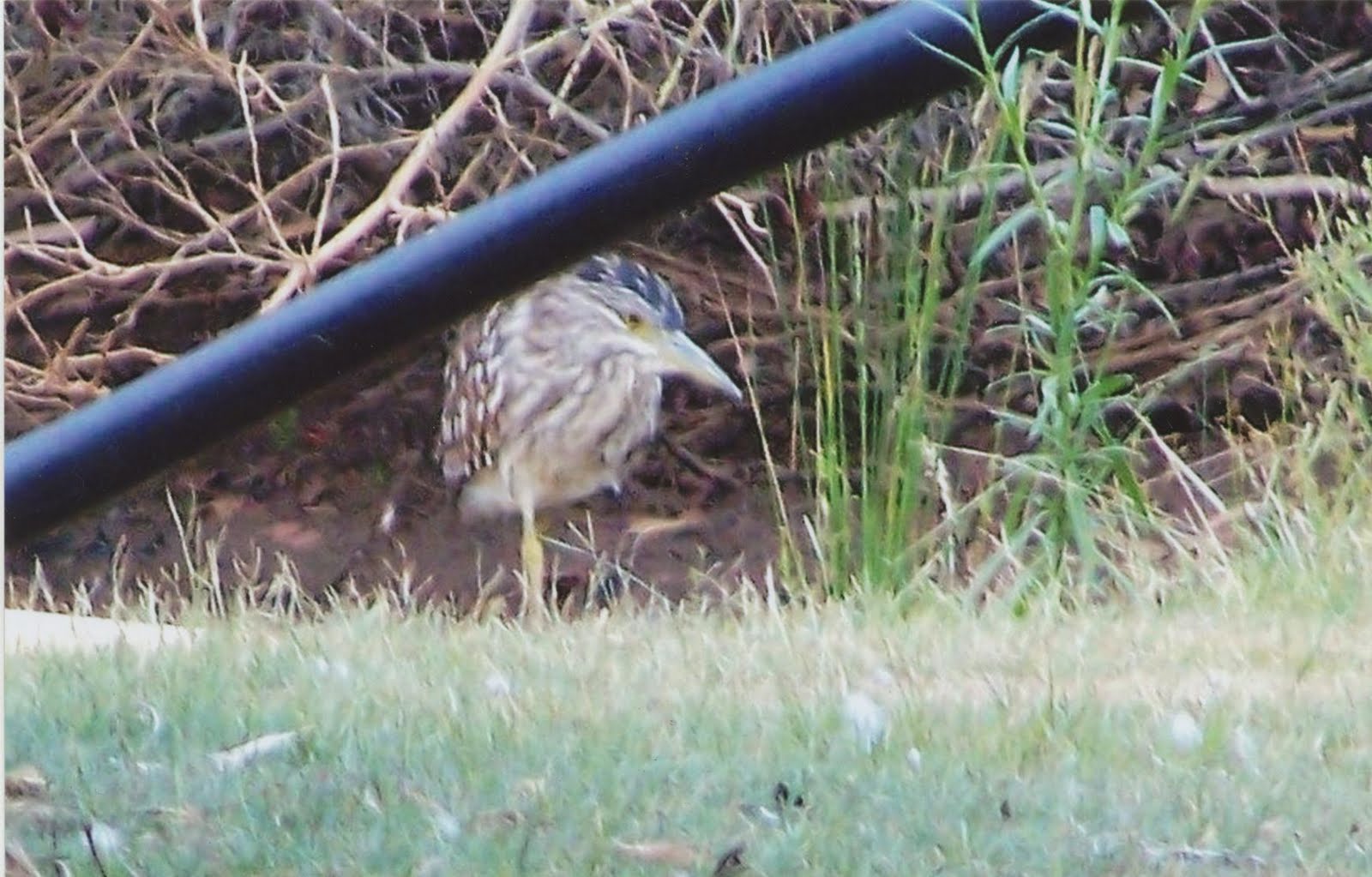
As if the parakeet wasn’t enough of a jolt to the system, Jeanette then proudly handed over her photograph of a “strange bird” she had photographed on the morning of 5 December 2011. She had spotted it skulking on the edge of their small front dam, under the pipe leading from pump to water – a Striated Heron Butorides striata!

Photograph by Jeanette McBryde.


Happy 2012 to one and all. May the new year bring you all those as yet unticked species and may all your birding experiences be pleasant but challenging.

Wednesday, November 9, 2011

The Cycle of Life

It is no longer appropriate to suggest that spring is on its way. It’s here! All around Allen Road there are the indisputable signs that, at least as far as the birds are concerned, it is spring and spring is the time of regrowth; a time for rebirth and the propagation of the next generation.

The Magpie-larks Grallina cyanoleuca have very conveniently chosen a tree immediately across from the front [east] verandah in which to build their nest – last year it was atop a tall tree up by the front gate, some 600m from the house and near impossible to spot even when standing directly beneath the nest. This year’s nest site is far more expedient for observation purposes; the telescope is already trained on the birds and nest-watching has become a regular breakfast-time activity.

Both birds work hard to feed the as yet indiscernible number of youngsters. The change-over routine has become an established pattern. The “off duty” partner returns to an outer branch of the Smooth-barked Apple tree Angophora leiocarpa, always announcing its arrival with that familiar Magpie-lark call; the “on duty” partner leaves the nest and the other takes over sitting/minding duties.

Their constant battle appears to be with the unwanted close attention of a Pied Currawong Strepera graculina, clearly determined to appease its own needs at the cost of the Magpie-larks’. At the moment the smaller larks appear to be holding their own against their larger adversary. On the approach of the currawong one or the other of the larks will immediately attack the predator and in this they are, on occasions, ably assisted by the Noisy Miners Manorina melanocephala who have their own youngsters nearby and therefore their own quarrels with the marauding Artamidid.
Their cause could also be aided by the fact that one of the two regular currawongs has lost its left eye. Oddly enough our good neighbours, Denis & Jeanette, two blocks away, report feeding what surely must be the same one-eyed bird. Even more curious, they have heard that friends of theirs, living a couple of kilometres away, as the crow [or rather, currawong] flies, have also been feeding a large, black and white one-eyed bird. What odds of two Pied Currawongs with a missing left eye in so small an area?

While seated, breakfasting on the east verandah, we are also at times privileged in being able to observe a pair of Dollarbirds Eurystomus orientalis in their courtship. In spite of their rather unassuming common name they are magnificent rollers [no doubt awaiting the moment some taxonomist will see them as Australian, Australasian or even Eastern Rollers- one calls even as I tap out the keys].

Their renowned aerial courtship display is in abeyance but they continue to perch on the dead outer limb of another of our angphoras – no more than five metres from the corner of the eastern and southern verandahs and again clearly visible while having breakfast or sipping a post-work glass of shiraz. Only yesterday we watched as first one and then the other alighted on the bare outer branch. The first bird appeared to touch bills with the later arrival but if this was an exchange of food the morsel was too small to be seen by the naked human eye. They have been seen allo-feeding on previous occasions so perhaps this was a simple bill-touching ceremony to strengthen bonding previously established between them.

Somewhere to the southwest we hear the desperate begging call of a young Torresian Crow Corvus orru and no doubt the loss of our chicken and duck eggs can at least in part be attributed to this. They have been noted flying away from the area of the henhouse with an egg in their bill, or we have come across empty, discarded shells on our walks between house and large dam on the southern boundary.

The Willie Wagtails Rhipidura leucophrys , Sacred Kingfishers Todiramphus sanctus and Grey Butcherbirds Cracticus torquatus are active as pairs although as yet we have no direct evidence of actual nesting or the rearing of young. The Striped Honeyeaters Plectorhyncha lanceolata have become more vociferous than previously noted, as indeed have the Olive-backed Orioles Oriolus sagittatus. Could these increased vocal displays indicate courting and/or more engaged nesting activities?

Whatever, clearly the cycle of avian life continues to flourish here at Allen Road.

Monday, October 3, 2011

Juggling Act

The more I become involved, the more it seems to me that running a regular birding blog has become akin to being a circus juggler. The most dominant ball of the act has to be one’s job and career, perhaps all the more so if that involves children [although no doubt there would be others, in different occupations, who could argue the same case for their particular line of work]. There remains the expected maintenance and upkeep of your property, exasperated if you deliberately elect to buy an older building that needs time, effort and increasing amounts of energy to renovate and modify.


Almost undoubtedly, it is perhaps my pedantic need to list, to write, that creates the greatest hurdles to blogging. With me it is not simply a matter of seeing and/or hearing a bird and committing the species to paper.


Yes, I do that.


Take Allen Road. Some years back I produced a simple recording sheet with columns for species name, number of birds noted, a H/S column to indicate whether the species was “Seen” or “Heard” [the former always taking precedence]. The last, and widest, column allows me to jot down a few notes as to location or observed behavioural traits. I even acquired a clipboard to provide a reasonable writing surface when recording this data.


All that, in itself, may have readers pondering the root cause of my professed dilemma. With a few adaptations, moderations, I have few doubts that most birders engage in some such system.


My difficulties, my obsession, starts later when I come to transcribe those basic “field” notes to a more substantial format. In the old days, before computers and the Internet invaded the 20th century, I simply copied rough notes into my journal – no self-respecting male birder back in those dim and distant days would ever have admitted to having a diary. Diaries were girls’ stuff, secret women’s business!


A number of birders I know have just dropped the journal entries and enter their bird records directly into a personal computer file, or record their sightings onto one of the growing number of public databases available online [Eremaea comes to mind as a widely used Australian example]. I have done this in the past and to a lesser extent, usually limited to the rarer species, I occasionally still commit sightings too the Birds Queensland Newsletter and/or their website.


However, unlike many of the above-mentioned birders, I have been unable to drop my old handwritten journal. My Allen Road records alone date back to April 2001, in an era before I had access to my own personal computer. I had access at school but that created another set of problems. Thus, I continued to keep a diary of birds noted on each visit to Allen Road and even to this day, when Fay and I live on the property rather than pay occasional visits, I continue the habit. Those records now run to three volumes and I would be loathe to suddenly drop that format.


I of course keep my own electronic records, a practice enhanced when I recently acquired a copy of Bluebird Technology’s simple, but very effective, Bird Journal [currently at version 2.3].

So, my records start with the basic field notes which are then transcribed to a handwritten journal and finally added to Bird Journal.


And the Allen Road records are the simplest of the birding records I keep! The South Burnett region becomes a mite more complicated while any birding trips further afield [e.g. our recent venture out to Sundown National Park] take on huge proportions. My handwritten entries are not merely simple notes, each trip is written up in full.


Which brings me to the original thrust of this blog. I had intended to keep a weekly account of our activities at Allen Road [as I had intended to do with the South Burnett in general] but one or more of the balls in the delicate juggling act keep slipping, spilling over, rolling away.

Once a month is now on trial.

This is a particular good month for birding activity in this neck of the woods. It is spring and that is the season of regeneration, of new life emerging into the world. I have written elsewhere [http://www.birdingsouthburnett.blogspot.com/] of the advent of spring. Allen Road has been mentioned in passing.


As with the South Burnett in general [always remembering that Allen Road is but a small corner within that entire region] Allen Road also displays clear signs that winter, albeit reluctantly judging by some of our more recent overnight lows, is waning.


The arrival of the Little Friarbird Philemon citreogularis as early as mid-August became the scout, the indicator that we were in for an early spring. A day later the Noisy Friarbird Philemon corniculatus made its presence known; in both instances we had heard these species elsewhere in the South Burnett – the Little as early as 3 July, the Noisy at school on 28 July- and July is normally considered to be mid-winter.


At the end of September the Olive-backed Oriole Oriolus sagittatus arrived. Later that same day [26 September] while walking back from the dam we heard the Australasian Figbird Sphecotheres vieilloti. Another duo of signs that spring is springing upon us.

Nevertheless, in secret Fay and I always await the arrival of one particular species before we are prepared to openly declare that winter has gone, that summer is around the corner. Not that we had long to wait. The first Sacred Kingfisher Todiramphus sanctus of the season was heard the following day, 27 September and later that same day we saw it perched on overhead wires along Allen Road.
Spring is here. We await the arrival of another handful of iconic species between now and the advent of summer.


The Spangled Drongo Dicrurus bracteatus we know is present a few kilometres down the road, in open woodland on the edge of Tarong Power Station. The Channel-billed Cuckoo Scythrops novaehollandiae and Eastern Koel Eudynamys orientalis have yet to make their presence known.

Saturday, September 3, 2011

WET but not so WILD


It rained. It rained. Now I know that is simply repeating the same short sentence twice but I felt the point needed emphasising. It rained. And then it rained some more. By day’s end the rain gauge registered 41.5mm of rain. To put this figure in perspective, August comes in as Nanango’s driest month with an average of 32.2mm. An overnight fall in excess of 40mm is, in anyone’s experience of an austral winter, a substantial amount of the wet stuff from the Heavens.

A number of possibilities immediately spring to mind when one arises on a Saturday morning to dark, threatening, clouds blanketing the world around you. As a birder you instinctively appreciate that any plans to go birding around the ridges is out of the question. No right-minded bird would risk a thorough drenching simply to oblige a passing human with the opportunity to focus a pair of binoculars on the finer points of its plumage. Both avian subject and human observer would return to base camp all the worse for the inclemency of the morning.

A second thought occurred almost as quickly: the Utility Room cupboard remains incomplete; indeed, has remained incomplete since originally blueprinted back in 2001! It could have been attended to during the recent January floods when Fay and I became isolated on our property but I was literally up to my neck, well, okay, up to my knees, in muck, mud, water and occasional enemy sniper fire. I sporadically drift into realms of fantasy.

Not that the persistent rainfall eliminated all possibilities of birding. When your accustomed hour of arising is somewhere between 0330 and 0400 hours - don’t ask, it’s a long tale of general lifestyle, diabetes and our continuing research into the local early birds - there is always time to listen out for, if not actually see, birds. The Tawny Frogmouth Podargus strigoides obliged. The Bush Stone-curlews Burhinus grallarius, crepuscular creatures, were howling by 0526 hours from somewhere east of the house.

Heavy overnight downpours have lead to an untested theory Fay and I are developing.

As a preamble I should point out that we are both unashamedly feeders of birds. We have been since our days in the U.K. My first introduction to serious birding was back in the days of my mid-teens, when Fay was merely my girlfriend [yes, we can be classed as childhood sweethearts even though we didn’t actually attend the same school- Fay was clever and went to the local grammar school; I was thick and went to the nearby secondary modern, although thereafter it seems to have become a comprehensive].

Boreal readers may well wonder why the above point is stressed. In the U.K. almost everyone we know feeds birds in one form or another. Our good friends, Keith & Jen of Albrighton, Shropshire, have established a rather elaborate feeder system in their back yard which can be observed at leisure from their conservatory. Les and Sandy of Tewkesbury, Gloustershire, have a simpler but very effective backyard feeder. In the USA feeding birds has become a multi-million dollar business. It is encouraged by birding authorities.

That is not the case here in Australia. Birds Australia, soon to be merged with Bird Observation & Conservation of Australia [formerly Bird Observers Club of Australia], more commonly referred to as BOCA, to form Birdlife Australia, actively discourages the feeding of wild birds. Or at least the organization does not encourage the feeding of wild birds. That same message is oft repeated at gatherings of Australian birders all around the country. The exponents of this particular “anti-ism” range from scientists with genuine but untested concerns to the ranters who could just as easily protest the universal acceptance that the Earth is an oblate sphere when in reality it is flat and all archival evidence from Outer Space to the contrary is a diabolical fabrication instigated by a perverse American government, hell-bent on the de-Christianization of the world.

We smile, we ignore and we continue to feed our local backyard birds. We are aware of the work by Brittingham et al. [1985] as we are aware of the work by Bromley & Geis [1998].

We note that no more than a few hours after gorging itself on titbits of cheese from our verandah, the male Grey Butcherbird Cracticus torquatus honoured us with a magnificent display of hawking. It perched on the east side of the tall angophora [the site of one feeder] and launched itself out into the open sky between tree and grapevine fence to catch small black insects that were visible to the naked human eye. At one point it landed atop the newel post of the front steps before swallowing its prey. The Noisy Miners Manorina melanocephala and Magpie-larks Grallina cyanoleuca, also regular visitors to Café Avian, joined in on the action. The humble juvenile Australian Magpie Cracticus tibicen, seemingly lacking the required aerial acrobatics, simply jumped into the air in an attempt to catch its share of black insects. We cannot comment on its success rate as it had its back turned to us.

I drift. Back to the developing, if as yet untested, theory.

Wild birds become more desperate for food supplements following a heavy overnight downpour.

We have no empirical evidence, no quantitative measures of seed, cheese or biscuit crumb mixture consumed during a post overnight rain session as compared to a “normal” [no overnight rain] feeding session. Currently it is no more than conjecture based on the evidence of our own eyes and the number of birds visiting our feeders.

Allen Road data date back to 2001. As well as species present we record climatic conditions; minimum and maximum temperatures along with rainfall figures and almost invariable the data indicates an escalation of the feeding frenzy on mornings following heavy overnight rainfall. Apostlebird Struthidea cinerea numbers explode. Rainbow Lorikeet Trichoglossus haematodus numbers fulminate. Crested Pigeon Ocyphaps lophotes and Bar-shouldered Dove Geopelia humeralis numbers increase dramatically. White-winged Choughs Corcorax melanorhamphos numbers can double. Galahs Eolophus roseicapillus seemingly emerge from out of the woodwork to engorge themselves on the proffered feast.

If not merely a climatic coincidence, why the sudden increase in numbers following heavy overnight rainfall? Are the birds simply hungrier? Does the amount of rainfall impact deleteriously on their normal food sources? Is it that the wet condition demand greater energy reserves and these are easiest procured from Café Avian than from out in the wild?

Or is it that heavy overnight falls of rain deleteriously effect insects, a major food source of many birds in our area?

Whatever, it seems a simple equation: the heavier the overnight rain the more frenzied the ensuing scramble for food at Café Avian. When we are presented with incontrovertible evidence to the contrary [that it is better for our backyard birds to starve than be provided with a supplementary food source] we may consider demolishing the feeders.

On the other hand, their presence around the place, amid the grevilleas and banksias, makes for a more pleasant life in general.


Tuesday, August 2, 2011

Battling Butcherbirds


As I may have said on a few previous occasions, there is one clear advantage of having your own “backyard” patch, a place you either visit regularly or, and some could argue better still, the place you actually live in. Allen Road comes into the latter category. Each day’s birding inevitably starts out as a list of birds Fay and I can hear while still lying in bed enjoying the morning’s first cup of tea. I often get to see the first bird while making the tea – yes, I’m old-fashioned enough!


In birding your own local patch you soon become familiar with the regular birds of that patch. You get to know them almost as individuals; indeed, I know some of my local birds better than I know some of my neighbours along Allen Road.


Take the two species of butcherbirds, part of the Artamidae family available in this neck of the woods; we have both the Grey Cracticus torquatus and the Pied Butcherbird C. nigrogularis present as residents. However, the former is a daily visitor to our verandahs in search of titbits of cheese or simply using the verandah roof as shelter from more inclement weather while the Pied is, with one notable exception, a bird that we only hear from our property although it is often encountered on our walks along Allen Road.


It has become a regular routine. Our third cup of tea [well, perhaps a few more cups during the shorter, colder mornings of winter] we have on an old miner’s couch on the east verandah. Almost invariably, within minutes of settling down, one or the other of the Grey Butcherbirds, usually the male –you can differentiate between the sexes when both are sitting a metre of less from you- arrives to perch on the top rail. It never makes a sound; it simply sits there looking at us. One or the other of us gets up to cut up the cheese, usually tasty cheddar [for those interested in the piddling minutia]. We toss bits of cheese into the air and enjoy the spectacle of the butcherbirds’ aerial acrobatics as they snatch the morsels from mid air.


In contrast, the Pied Butcherbird, a much larger species, with the one aforementioned exception, has only ever been recorded as “heard only” on our property bird records. We simply don’t expect to see it until our winter weekend or summer evening walks along the road.


That is until the other day. The weather was abysmal. It was cold, ground temperatures plumbing perilously close to zero. It had rained heavily overnight, bringing back memories of last January when Fay and I became isolated on our own property for three days. The morning light was impossible. All was gloom and climatic doom.


As we sat with that welcome cup of tea the male Grey Butcherbird suddenly alighted on the top rail of the east verandah; we could see its mate perched in the nearby angophora. The normal routine ensued. I tossed the male a piece of cheese and then leaned over the rail to toss a piece towards the female in the tree. She never stood a chance. In a flash the cheese was snatched in mid air by a Pied Butcherbird, a much larger close cousin, which clearly had been waiting on the roof. Fay and I were stunned.


Apart from the exceptional agility displayed by the bird, how had the Pied learnt that this was the local Café Avian? It had never previously sought additional food supplements from us. I tossed a second piece to the male Grey and again tossed a piece towards the female in the tree. The Pied intercepted it.


This continued for several throws until both Grey and Pied departed; the former to return later that afternoon.


We were granted a second showing of the Pied Butcherbird’s lissom acrobatic prowess the following day when again it swooped down from the rooftop to intercept pieces of cheese intended for the Grey Butcherbirds. My fingers worked overtime tapping in this newly discovered data into the Bird Journal program.


This week we experienced a repeat performance but with rather a sharp twist to the tale. The Pied Butcherbird arrived earlier than the pair of Grey Butcherbirds and duly took the first morsel of proffered cheese. It perched on the corner of the east and north verandahs and I had just turned away to resume drinking my tea when a flash of feathers skimmed by close to my left ear; there was a distinct clack of wing beats. I stopped, amazed, puzzled. Had I just been attacked, warned off by some unseen bird?


I spotted a Grey Butcherbird in the sapling at the edge of the track leading to the house. Had it been the culprit, the unseen attacker? The question was answered a moment later when the Grey took off and swooped in on the verandah corner – straight at the Pied, only averting certain collision at the last moment. Again, the clack of wings indicted that this was no chance encounter but a deliberate assault by the Grey Butcherbird on its close cousin, the Pied Butcherbird.

Again, moments later, the Grey attacked the Pied in a deliberate offensive. On the next assault the Pied Butcherbird clearly decided that discretion was the better part of valour and beat a hasty retreat back towards the west of the property.

There has been no repeat appearance by the Pied Butcherbird since that ignominious defeat.

Monday, July 18, 2011

Mellow Yellow

As I may well have said before, there is one outstanding advantage in having your own “backyard” birding patch; you get to know your local avifauna. The regulars are there or, if they suddenly cease to be there – and it’s not the migratory season- then you soon notice. You may never know the why this or that particular species has suddenly stopped being among the more common residents or at least frequent visitors but you become aware of the situation and mull over the possibilities. Fay and I continue to mull over the sudden exit of our Yellow-faced Honeyeaters Lichenostomus chrysops; the demise of the Speckled Warblers Chthonicola sagittata and White-throated Scrubwrens Sericornis frontalis could be feasibly accounted for because of the decade-long drought which decimated the understorey, thus depriving these skulkers of adequate cover.

Nevertheless, overall, a backyard patch allows you to become intimately familiar with your local birds.

Occasionally the set routines are pleasantly disturbed by the unexpected arrival of an avian stranger, or at least an infrequent caller.

The other day, while walking through the wooded northwest quadrant of our property, an area set aside as sacrosanct to the wildlife and not to be interfered with by us throughout our sojourn at Allen Road, we suddenly heard the distinctive call of Yellow-tailed Black-Cockatoo Calyptorhynchus funereus. It took a little craning of necks, bending of backs to see around or over various shrubs and trees but we soon spotted movement further down [west] Allen Road. Fay counted four flying across the road. A moment later and we heard the plaintive cry of a juvenile cockatoo wanting to be fed.

By the time we had returned to the house, a long list of chores awaited our attention, the Yellow-tails sounded as if they had swung around and were closer to our own property; then on our property, somewhere in the wooded southwest quadrant and another calling from directly west [in Rudolf’s former place]. Fay spotted the two from the southwest; I saw one alight in a tree just on the other side of the western fence.

We stopped our various tasks and looked closer. One Yellow-tailed flew across to the tall, but sadly dead, tree on the edge of the track leading to the front gate. From this lookout post it called incessantly and before long five other Yellow-tails flew across the property, collected the lone pleader and all six disappeared further east along Allen Road.

Yellow-tailed Black-Cockatoos are more an uncommon than a rare occurrence along Allen Road but they come infrequently enough to cause at least a mild stir in the bosom of any local birders.